
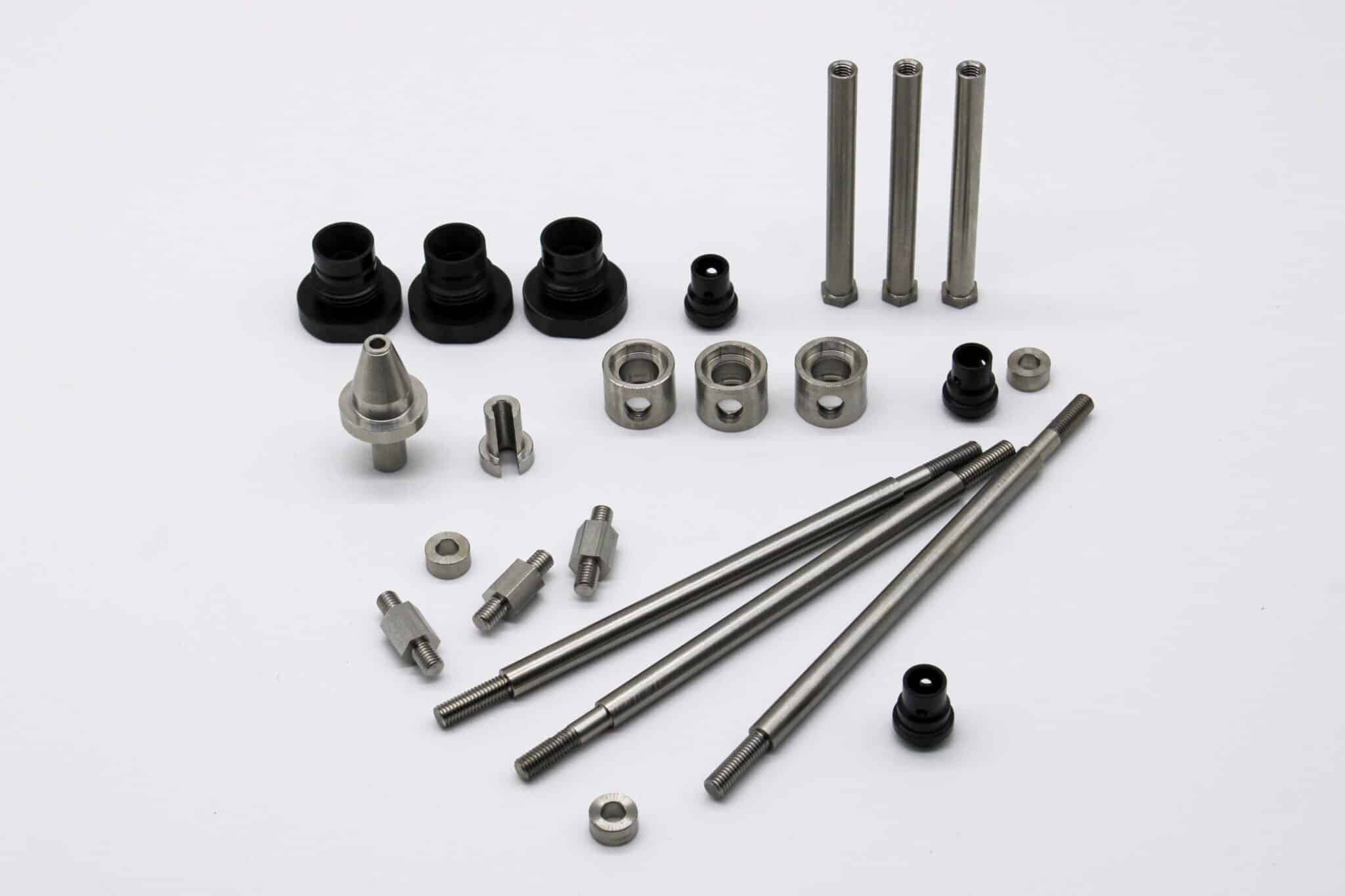
Hydraulic systems transfer power via a pressurised fluid, and their reliability depends on the ability to keep that fluid exactly where it needs to be. Every fitting, every seat, and every mating surface is a point where the circuit can hold or give way, and the difference between the two conditions comes down to fractions of millimetres and surface finishes measured in micrometres.
Because of this, the quality of the turned components that make up the system is not a production detail, but the base upon which they rest performance, security and Duration of the entire system.
MI.SO. manufactures custom-made precision metal small parts, with turned components capable of meeting the requirements of the hydraulic sector, where they must work in the presence of fluids, moisture and pressure. In this field, dimensional precision and surface finish are not aesthetic requirements, but the technical conditions that make sealing possible.
Why sealing is the critical requirement in hydraulic circuits
In a hydraulic circuit, the fluid performs work under pressure and transmits power from one part of the system to another. Any leak, even a minor one, results in a drop in pressure that reduces system efficiency, a loss of fluid that increases operating costs and, in the worst cases, a risk to operator safety and the surrounding environment.
A leak is almost never the result of a sudden failure, but rather the result of a joint which, over time, has failed to maintain the geometric and surface characteristics specified in the design.
The working conditions make the task even more challenging. The hydraulic components are exposed to cycles of pressure repeated, to vibrations transmitted by pumps and actuators, to temperature fluctuations which cause the metal to expand and contract, and at the continuous contact with fluids that may be corrosive. The sealing of the circuit, therefore, does not depend on a single element, but on the quality with which each of its component parts is made. A fitting with an out-of-tolerance seat or too rough a surface introduces a weak point that no gasket can fully compensate for.
How turning precision guarantees the seal
It is worth clarifying a point that is often misunderstood: the seal of a hydraulic connection does not rely solely on the gasket. The elastomeric element, where present, operates against a metal surface and within a machined seat, and its effectiveness depends entirely on how that surface and that seat have been made.
Furthermore, in many connections, the seal is achieved by direct metal-to-metal contact, without any elastomeric element. In both cases, the result comes from machining of turned components.
Dimensional tolerances and surface finish
La surface finish it is one of the parameters that determine whether a surface seals or allows fluid to pass through. A surface that is too rough has crests and valleys that form microchannels through which fluid can seep, and in the presence of moving seals, the asperities act as small blades that scratch and wear out the sealing element. A surface that is too smooth, at the opposite extreme, does not retain the lubricant film necessary to prevent dry friction.
There is therefore a window optimal, which in the seals sector is roughly between 0.4 and 1.6 micrometres of average roughness (Ra) for static sealing surfaces, with finer values, in the region of 0.3 micrometres, for moving surfaces such as rods.
With turning This window is controlled by adjusting the processing parameters – in particular on the tool feed and nose radius – which together determine the theoretical profile roughness. To this is added the tolerance control dimensional: the diameter of an O-ring housing, the depth of a groove, the male and female fitting of a connector must respect tight margins, because the correct compression of the seal and the precision of the metal contact depend on those margins.
A fleet of sliding headstock lathes allows MI.SO. to work with diameters from 3 to 32 millimetres while maintaining tight tolerances and repeatable finishes throughout production, which is a prerequisite for the components to behave uniformly once assembled in the system.
With its own machinery MI.SO. achieves roughness values of up to approximately 0.8 µm Ra, which fall within the window required for static sealing surfaces.
Sealing geometries: seats, O-ring grooves and threads
Hydraulic connections achieve sealing in different ways, and each of these imposes on the turned component a precise geometry. In metal-to-metal joints, contact occurs between coupled conical surfaces, with standardised angles that establish a continuous line of contact between the two elements: these are the classic 37-degree flares, 60-degree cones and 24-degree ports widespread in international standards.
For the seal to work, the cone angle and finish must be made with utmost regularity, so that the contact is distributed evenly along the entire circumference.
In O-ring seals, on the other hand, the elastomeric element sits in a groove machined into the component and is compressed against a mating surface. The geometry of the groove—namely width, depth, and fillet radii—determines the degree of compression and therefore the effectiveness of the seal, while the surface against which the O-ring operates must meet the finish requirements already described. Added to this are the threads, which can be parallel, when sealing is provided by an O-ring or a dedicated gasket, or tapered, when the deformation of the thread itself ensures the seal.
In all these cases the sealing function is written in the part geometry, and it is precision turning that translates the drawing into a component that holds.
The materials chosen by MI.SO. for the hydraulics sector
In the hydraulics sector, materials they must guarantee first of all resistance to corrosion and prolonged contact with water and fluids, combined with the ability to withstand the stresses pressure-related mechanics. MI.SO. selects the material according to the application, taking into account the’environment work, of the fluid employee and of the requirements machinability of the component.
Stainless steels: AISI 303, 304 and 316
Stainless steels are the go-to choice when you need corrosion resistance and long-term reliability. The’AISI 303 it offers good corrosion resistance combined with excellent machinability, making it suitable for screws and fittings for plumbing systems.’AISI 304 It lends itself well to applications in humid environments thanks to its high resistance.’AISI 316 it represents the highest level of protection, indicated in the presence of corrosive fluids and chlorides, where other stainless steels would not offer sufficient guarantees.
Brass CW510L
Brass CW510L it is a material historically linked to the world of plumbing fittings. It combines a good durability to corrosion with characteristics of machinability which allow precise sealing geometries to be obtained, which is why it is frequently used in fittings and components where a reliable circuit closure is required.
Free-cutting and alloy steels: AVP, AVZ, PR70 and PR80
Free-cutting steels such as’AVP, leaded high-speed steel, and the’AVZ, lead-free high-speed steel, are used in precision hydraulic components thanks to their excellent workability, while proving less suitable in highly corrosive environments.
Alloy steels PR70 and PR80 instead they offer a different profile: the PR70 combines a good resistance to corrosion to a hardness suitable for pipes and fittings, while the PR80, in the galvanised version, adds a protection anti-corrosion and a resistance useful for fatigue in joints subjected to repeated stress.
ERGAL 6082 aluminium and PEEK and POM-C engineering plastics
Aluminium ERGAL 6082 it is suitable for structural parts exposed to fluids and pressure, where a high strength-to-weight ratio.
On the engineering plastics front, the PEEK is the choice for high-performance hydraulic components that require high chemical and mechanical resistance, whilst the POM-C, which is highly resistant to damp, is used in guides and brackets where it is required dimensional stability and fluency.
MISO turned components for hydraulics
The range of small metal components that MI.SO. manufactures to specification for the hydraulics sector includes parts which, within the circuit, perform the functions of link, guide and adjustment:
- Pistons, piston rods and cylinder rods, where dimensional accuracy and surface finish determine smoothness and dynamic sealing.
- Pipe fittings, where the sealing geometries and threads ensure leak-free connections.
- Bushings and spacers for valves and regulators, components that may appear simple but are critical to the correct positioning of the moving parts.
- Pressure reducers, where tight tolerances govern the behaviour of the fluid.
- Precision components for linear actuators, which require precise mating for reliable long-term operation.
Quality control and dimensional checks to ensure a tight seal
The sealing of a hydraulic component is determined by measures, and that is why dimensional control is an integral part of the production process, rather than an additional stage at the end. Every day, MI.SO. carries out approximately 130 quality controls on workpieces in progress, making use of metrological instrumentation such as the Keyence IM-8020 optical measurement system and the Zeiss O-Inspect 322 multi-sensor machine, which enable the verification of diameters, geometries and surface finishes with the precision required for sealing surfaces.
This ongoing monitoring forms part of a certified quality management system ISO 9001:2015, which ensures the repeatability of results and the traceability of tests. For a component intended for use in a pressurised circuit, the assurance that every part complies with the design tolerances is what distinguishes a reliable supply from a potential source of leakage.
Co-design and design optimisation
Many sealing problems are prevent at the design stage, even before the part reaches the machine. This is why MI.SO. works alongside the customer in co-design phase, by jointly assessing the component’s design to identify solutions that improve machinability, optimise sealing geometries and reduce the risks associated with excessively tight or unnecessary tolerances. A technical review carried out at this stage enables us to achieve a part that is more simple to be produced consistently and, at the same time, more reliable once it has been fitted to the system.
Whether it’s fittings, bushings, pistons or actuator components, the collaboration It is the relationship between the client and the supplier that makes it possible to turn a sealing requirement into a turned component that actually meets that requirement.
Would you like to manufacture precision small metal parts for your hydraulic systems?
Get in touch and tell us about your projectWe support you from design to production.
Send us your technical drawing with dimensions, quantities and material, and our team will propose the most suitable solution to guarantee sealing, precision and reliability over time.