
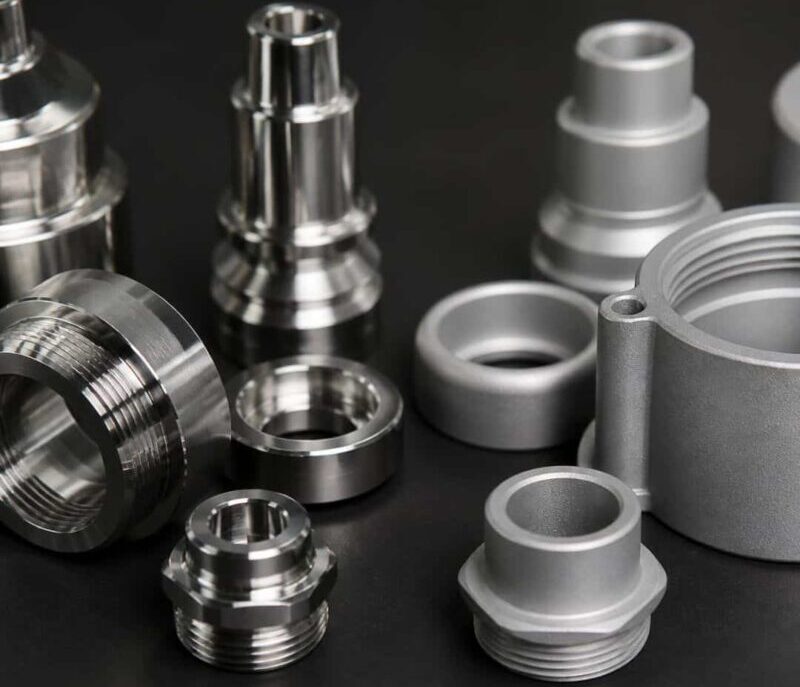
In data centre cooling circuits, the choice of material is not a detail, but a decision that impacts performance, Duration e reliability of the entire system. Stainless steel e aluminium are the two protagonists of this choice, and the question that is heard most often, as to which is the better one, is actually misguided. There is no absolute winner, there is the right material for a given function and specific operating conditions. Understanding how to choose between stainless steel and aluminium for data centre cooling means considering the role of each component and the environment in which it will have to operate.
Two metals, two vocations
Before comparing them, it is advisable to establish the fundamental characteristics, because almost every practical consideration stems from there. The’aluminium è light e it conducts heat very well, with a thermal conductivity of the order of 150 W/m·K, about ten times higher than that of stainless steel, which stops at around 16 W/m·K. On the other hand,’stainless steel it is much more corrosion-resistant and mechanically more robust, as well as being about three times heavier, with a density of around 8 g/cm³ compared to aluminium's 2.7 g/cm³.
From these differences arises a natural division of tasks. Where needed transfer heat quickly or keep the weight down, l'aluminium He has the advantage. Where they are needed Estate, pressure resistance and above all corrosion resistance in the long run, the’stainless steel becomes the most solid choice. Thermal conductivity, which seems to be the decisive parameter, is not at all for many components, as we shall see.
L'aluminium, when lightness and heat exchange matter
Aluminium is at its best in elements that need to dissipate heat, because its high conductivity allows rapid transfer of energy from the hot spot to the fluid. To this is added the advantage of reduced weight, which is useful when a system contains many components or when lightness simplifies assembly and maintenance.
In practice one does not speak of pure aluminium, but of alloys. The most widespread in precision mechanics belong to the family ERGAL: il 6061 and the 6082 they offer a good balance of workability, corrosion resistance and conductivity, whilst the 7075 it prioritises mechanical strength, reaching load values almost double those of 6061, in exchange for slightly lower conductivity. Furthermore, aluminium is machined with great efficiency, which makes it suitable for high-volume precision production.
There is, however, a flip side. Aluminium naturally forms a protective oxide layer, but it remains susceptible to localised corrosion, the so-called pitting, when the fluid contains impurities or when the pH is not controlled. For this reason, in circuits that use it, the chemistry of the refrigerant must be managed carefully, maintaining the pH within a correct range and using corrosion inhibitors, all the more so since glycol mixtures tend to form acidic compounds upon oxidation.
One must also consider a lower dimensional stability with temperature variationsaluminium has a higher coefficient of thermal expansion than stainless steel, so it expands and contracts more, and in a circuit subjected to daily thermal cycles this can stress joints and sealing surfaces.
L'stainless steel, when grip and longevity count
Stainless steel approaches the problem from the opposite angle. Its low thermal conductivity makes it poorly suited for heat exchangers, but it is perfect for all components whose function is not to conduct heat, but rather contain the fluidfittings, couplings, valve bodies and sealing surfaces. In these cases, what matters is the corrosion resistance even in contact with deionised water, the durability over time and the mechanical stability under pressure and thermal cycling, all qualities in which stainless steel excels.
Among the most commonly used degrees, the’AISI 304 offers excellent corrosion resistance under most conditions and is valued for its good machinability.’AISI 316 adds the molybdenum, which significantly improves the resistance in the presence of chlorides and in more aggressive environments, which is why it is preferred when water quality or operating conditions are more severe.
A useful note concerns the’AISI 303, very workable thanks to the addition of sulphur, which however reduces the corrosion resistance. Therefore, this is not the recommended choice for parts in direct contact with the fluid, whereas it may still be suitable for mechanical components not wetted by the refrigerant.
The real technical hurdle is galvanic compatibility
The most delicate point, and often the most underestimated one, does not concern the individual material but the coexistence of different materials. When different metals coexist in the same circuit immersed in the refrigerant, which acts as an electrolyte, conditions for galvanic corrosion are created: the less noble metal acts as an anode and corrodes more rapidly. The classic case is the coupling between aluminium and copper, in which the aluminium tends to deteriorate, with the risk of leaks over time.
This changes the way we think about material selection. It is not enough to ask which is the best for an isolated component, we need to assess the entire circuit. The safest route is to use the same materials – or materials with a similar electrochemical potential – along the entire fluid path. When this is not possible, recourse is made to insulation solutions as non-conductive bushes and dielectric joints, a surface treatments and then passivation of stainless steel, in addition to a accurate check of coolant chemistry, from conductivity to pH, right down to the inhibitors. The ratio of the surface areas also matters: a small anodic component connected to a large cathodic surface area corrodes much more rapidly.
How to choose, in practice
Bringing these elements together, the choice of material follows a logic of function and per terms and conditions, rather than a fixed hierarchy.
- Heat transfer surfacesthey favour conductivity, so aluminium, in ERGAL alloys, is often the go-to choice.
- Fluid-contacting components with sealing and connection functions (fittings, couplings, valves): they prioritise corrosion resistance and sealing, hence stainless steel, using AISI 316 in the most aggressive conditions and AISI 304 in standard ones.
- Mechanical parts not in contact with the coolantthey can use more workable grades such as AISI 303, where corrosion is not a factor.
- Consistency of the entire circuitwhatever the choice, the materials must be evaluated together with the fluid and the other components, to avoid problematic galvanic coupling.
In short, the right material is the one that is consistent with the component's function, the type of refrigerant, the operating pressures and temperatures, and the rest of the circuit. Alternative solutions also exist for special cases, such as certain brass alloys or technopolymers, but the two main references remain stainless steel and aluminium.
The machining of stainless steel and aluminium at MI.SO.
Translating these choices into real components requires the ability to machine both material families with the same precision, because stainless steel and aluminium behave very differently during machining. The’aluminium allows rapid removals e good finish, while the’stainless steel, harder and less conductive, requires a closer inspection and tools parameters to guarantee flawless dimensions and sealing surfaces.
At MI.SO. we work with both AISI 304 and 316 stainless steels and ERGAL 6061, 6082 and 7075 aluminium alloys, creating for precision turning the connection components of the cooling circuits, with diameters from 3 to 32 mm on 22 CNC sliding-head lathes.
For each material, the quality control remains the same: 130 daily checks with optical and three-dimensional measuring instruments such as the Keyence IM-8020 and the Zeiss O-Inspect 322, and traceability ensured by ISO 9001:2015 certification. In this way, whatever the most suitable material for the application, the component maintains the dimensional consistency and surface quality upon which the circuit seal depends.
Choosing between stainless steel and aluminium does not mean finding the absolute best metal, but rather the right one for the component's function and consistent with the entire circuit in which it will operate.
Do you want support in choosing the material most suited to your precision components for data centre cooling?
Get in touch!