
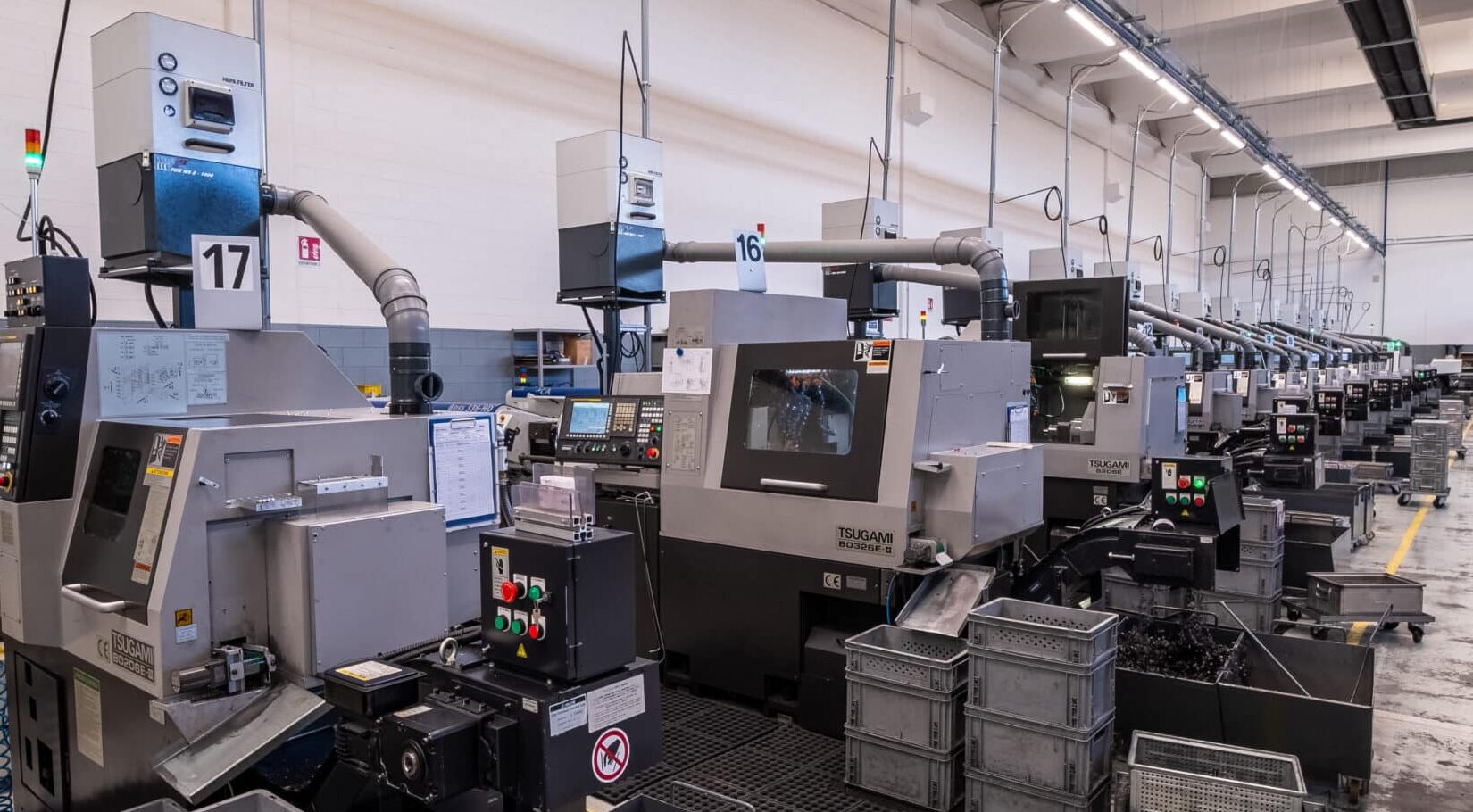
In precision turning, the number of axes on a machine is a concrete measure of what can be produced, in what time, and with what precision: more axes mean more operations executable in a single cycle, more complex geometries reachable without moving the piece, and shorter production times.
In MI.SO. we also have return to the mobile jockey with configurations up to 8 and 9 axes – TSUGAMI BO208WE (8 axes, diameters 3-20mm) and TSUGAMI BW329ZE (9 axes, diameters 6-32mm) – designed to tackle the complex small parts that the automotive, food, tyre, hydraulic and design sectors require of us every day.
What does it mean to work with 8 or 9 axes
A conventional lathe works on a few axes: workpiece rotation and linear tool movement. Adding axes means adding directions of movement, powered tools and the ability to perform different operations – Turning, drilling, milling, tapping – in the same cycle, without removing the workpiece from the machine.
With 8 and 9 axes, the workpiece enters rough and exits finished: all machining operations are completed in a single setup. This radically changes how complex components are produced.
Machining operations possible with 8-9 axis lathes
Main turning and simultaneous moving heads
Le macchine multi-asse dispongono di several axes of movement. A lead mare and a foal working simultaneously. While the main collet performs the turning on the front side, the other can work on the rear of the component in parallel, eliminating manual repositioning and effectively halving cycle times on parts requiring machining on both faces.
Cross and radial drilling
Additional axles allow to to position motorised tools in different directions relative to the main axis of the workpiece. The result is the possibility of performing transversal, radial, and angled drilling operations – holes that are not parallel to the lathe's axis, but pass through it laterally or diagonally directly during the production cycle, without additional setup.
For components such as hydraulic fittings with multiple connections, valve bodies, or pins with transverse through-holes, this capability is decisive.
Machining and flat profiles
multi-axis power tools allow perform milling on cylindrical surfacesFlat sections on cylindrical profiles, hexes, longitudinal or helical splines, keyways. Operations that on a conventional machine would require a second pass on a dedicated milling machine, are here completed within the same turning cycle.
Special machining and threading
Tapping the creation of internal threads – can be carried out on more faces of the component, in different directions, in the same setup. For components with multiple threaded connections on different axes, such as certain types of fittings or valve bodies, this capability completely eliminates intermediate steps.
Grooves and complex geometries
With 8-9 axes, it is possible to create grooves, slots, variable cross-section profiles, and asymmetric geometries that on machines with fewer degrees of freedom would require special tools or additional manual machining. flexibility of movement The axes.
Simultaneous processing
The most significant advantage of 9-axis configurations is the ability to perform more operations in parallelwhile one tool turns the external diameter, a second can drill, and a third mill. Overlapping operations drastically reduces cycle time compared to executing them sequentially.
The concrete benefits for those who produce complex small parts
One setup, zero repositioning
Every time a part is removed from the machine and repositioned for subsequent processing, a margin of error is introduced. Repositioning is never perfect: there are centring tolerances, clamping variations, micro-differences which, on components with tight tolerances, become non-conformities.
With the 8-9 axis lathes, the part does not come off. Moved during processing. All operations take place with the same clamping reference, ensuring superior dimensional accuracy compared to any sequence of operations on separate machines.
Reduced cycle times
The combination of simultaneous operations and the absence of intermediate setups results in significantly shorter cycle times compared to the alternatives. On a component that would require three steps on different machines, a 9-axis lathe can complete everything in a single cycle, with a reduction in time that, depending on the complexity of the part, can be very significant.
Optimised production costs
Shorter cycle times and a single setup mean lower production costs per piece. Less handling, less tooling, less risk of scrap between one process and another. For high volumes, this efficiency translates into a direct economic advantage for the customer.
Consistent quality across the entire range
La Repeatability is one of the key features of multi-axis CNC lathes. With defined parameters and a fully automated cycle, every part in the series is produced with the same movements, the same times, the same results. From the first to the last.
Our two TSUGAMI machines
TSUGAMI BO208WE: 8 axes, diameters 3-20mm
Designed for fine, small-diameter components, the BO208WE covers the range from 3 to 20mm with 8 axes of movement. It is the ideal machine for small, complex components that require multi-face machining, cross-drilling, or milling, typical of the electronic, medical, and automotive sectors for small-section components.
TSUGAMI BW329ZE: 9 axes, diameters 6–32mm
With 9 axes and a diameter range from 6 to 32mm, the BW329ZE is the machine for the most complex and largest-section components. It is the suitable tool for valve bodies, hydraulic and pneumatic fittings, medium-sized automotive components, and anything requiring the highest degree of machining freedom on parts up to 32mm in diameter.
Applications per sector
Automotive. Transmissions, braking systems and hydraulic systems often require complex geometries with cross-drilling, multi-axis threading and tight tolerances. The 8-9-axis lathes allow these components to be produced in a single cycle, with the precision and repeatability required by automotive qualification processes.
Food. Fittings, valves and components for food machinery made of AISI 304 or 316 stainless steel often have intricate geometries with multiple ports and cross-holes. Single-setup machining guarantees the necessary precision and facilitates the traceability required by food certification processes.
Pneumatic e plumber. Valve bodies, fittings and pistons for pneumatic and hydraulic systems are among the components that benefit most from multi-axis machining: complex geometries, multiple threads on different axes, tight tolerances on diameters and lengths. With 8-9 axis lathes, these components are completed in a single cycle without compromising on quality.
Design and furniture. Aesthetic components in brass, aluminium or stainless steel for the design sector often require excellent surface finishes and particular geometries. The possibility of completing all machining operations in a single setup eliminates repositioning marks and guarantees consistent surface quality, even on small batches.
Do you have a complex component to produce? If your project requires components with intricate geometries, multi-face machining, or tight tolerances on diameters up to 32mm, our 8-9 axis lathes are the answer.
Contact us and share the technical drawingOur technical office analyses feasibility and proposes the most efficient processing cycle in terms of quality, time, and cost.