
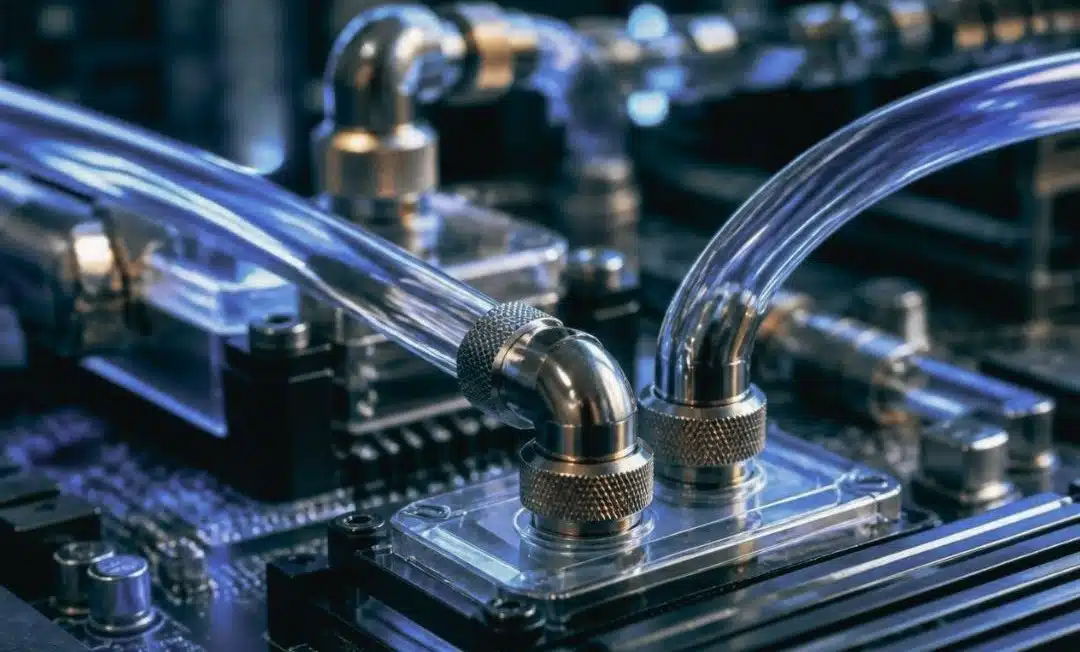
With the passing of data centres from cooling in the past, the circuit that carries coolant to the processors has become an air-to-liquid one, critical mechanical system how much the electronic part that needs to protect. Its reliability, however, does not depend solely on large elements such as pumps and heat exchangers, but above all on the myriad of small pieces holding the system together. Components for data centre cooling circuits are largely made of fittings, grafts, Valves e Adapters worked with Very tight tolerances, because that's where the difference lies between a system that works for years without leaks and one that fails at the first stress cycle.
A liquid cooling circuit is made up of several components working together: 1. **Radiator:** This is where the heat is dissipated. It's a finned metal structure, usually copper or aluminium, with channels for the liquid to flow through. Fans are typically mounted on the radiator to blow air through the fins, speeding up heat transfer. 2. **Pump:** This is the heart of the system, circulating the liquid coolant throughout the loop. It's usually an electrically powered pump designed for quiet operation and reliable flow. 3. **Water Block (or CPU/GPU Block):** This component attaches directly to the heat-generating component (like a CPU or GPU). It features a base plate that makes contact with the component's surface and an internal structure with fins or channels that the liquid flows through, picking up heat. 4. **Coolant (Liquid):** This is the fluid that absorbs heat from the components and carries it to the radiator. It's usually a mixture of distilled water and additives to prevent corrosion and algae growth. 5. **Tubing/Hoses:** These flexible or rigid tubes connect all the components, forming a closed loop for the coolant to travel through. 6. **Reservoir (Optional but common):** This is a tank that holds extra coolant. It serves a few
Before going into the detail of individual parts, it is necessary to have an overall idea. The reason why liquid is chosen is known: for the same volume, a liquid transports heat to an extent enormously superior compared to air, in order of around three thousand times, and this allows otherwise unmanageable power densities to be cooled.
A typical plant is organised on two circuits connected by a heat exchanger. The Primary circuit it interfaces with the building's water or with the cooling towers, while the Secondary circuit delivers the coolant directly to the hardware. The heart of this stage is the CDU (Coolant Distribution Unit), the unit that conditions and pressurises the fluid. From here the refrigerant reaches the manifolds, known as manifold, which distribute it evenly to individual servers, where the cold plates, the Cold plate, which brings it into direct contact with processors and GPUsGraphics Processing Unit, processor specialised in parallel computing)
Throughout this path the fluid passes through a dense network of connectionsflexible hoses, quick couplings, fittings, valves, and temperature, pressure, and flow sensors. It is precisely these connections, more than the piping itself, that determine the Estate and the’reliability of the entire circuit.
Why are precision components the critical point?
There is a rule that applies to any pressurised system: it is only as reliable as its weakest connection. In a data centre, this rule becomes particularly stringent, because every fitting is a potential leak point, and a refrigerant leak doesn't just mean system downtime, but also the risk of damaging extremely high-value hardware, with costs of inactivity measured in thousands of euros per minute.
The stresses these components are subjected to are far more demanding than they appear. The circuit operates under pressure, experiences peaks on start-up and shut-down, is subjected to daily thermal cycles, and continuous vibrations. Under these conditions, a component with imperfect sealing surfaces or approximate tolerances will be the first to fail, often silently: the leak starts small, alters the balance of flows, and degrades performance even before an alarm is triggered. This is why, when switching to liquid, small components stop being mere details and become genuine Risk management tools.
Components that originate from precision turning
Many of the components that make up a cooling circuit are small metallic parts with rotational geometry, which is exactly the type of component that arises from precision turning. The main ones are:
- Fittings and adaptorsThey connect circuit sections with different diameters or threads and allow transitions between various standards, including reducers, hose connectors, and nipples.
- Quick graftings (quick-release coupling): allow servers to be connected and disconnected without stopping the plant and without dripping, an essential function for maintenance; their bodies, seats and internal throats require very precise machining.
- Valve bodies and seats: isolation, vent and safety valve elements that regulate flow and protect the circuit from abnormal conditions.
- Bushings, collars and ferrulesClamping, guiding and retaining components that ensure the correct coupling and mechanical stability of connections.
- Seals and housing seatssurfaces that house O-rings and seals, where surface finish makes the difference between a perfect seal and leakage.
To these are added numerous threaded small parts and small connecting elements which, although going unnoticed, constitute the connective structure of the entire system. In the specific case of quick couplings, the sector is moving towards open and shared standards, such as the specifications UQD promoted by’Open Compute Project, which make components interchangeable between different manufacturers: another reason to work with strict and constant tolerances over time.
The technical requirements that make the difference
Making these components isn't a matter of simple turning, but of fine control of some critical parameters, each of which directly affects the reliability of the circuit.
- Tight tolerances and repeatabilitythe coupling quotes and sealing diameters must remain constant from piece to piece, even on batches of tens of thousands of units.
- Guaranteed estateThe gasket contact surfaces must be free of burrs and imperfections, and the components are verified with pressure leak tests to ensure the absence of leaks.
- Low pressure lossthe internal geometry and finishing of the ducts influence fluid flow resistance; an overly restrictive duct forces pumps to work harder, leading to increased consumption.
- Resistance to pressure, thermal cycles and vibrationsThreads and surfaces must maintain their characteristics over time, without deforming or loosening.
- Fluid compatibilityThe material must withstand the circuit environment, whether it be deionised water, glycol mixtures, or dielectric fluids.
Precision and traceability: MI.SO.'s contribution.
It is in this scenario that MI.SO.'s work fits: we create Precision components for cooling circuits, working Small turned metal parts with diameters from 3 to 32 mm on 22 CNC sliding head lathes. This is the typical format for fittings, connectors, bushes, and small threaded parts, where dimensional consistency on large volumes becomes critical.
On components of this type quality control It's not an accessory step, but an integral part of the process. At MI.SO., 130 quality checks are carried out each day, using optical and three-dimensional measuring instruments such as the Keyence IM-8020 and the Zeiss O-Inspect 322, which allow us to verify critical dimensions, threads, and sealing surfaces with high precision. ISO 9001:2015 certification also ensures the traceability of our processes, a requirement that is increasingly requested in a sector where every component must be documentable and traceable back to its production batch.
The choice of material with which we make these pieces – from the’stainless steel All’aluminium -depends on the fluid, the pressures and the operating conditions.
In the transition from air to liquid, connection components stop being marginal details and become the elements on which the operational continuity of a data centre literally depends.
Would you like to evaluate the feasibility of a precision component for data centre cooling circuits?
Get in touch!