
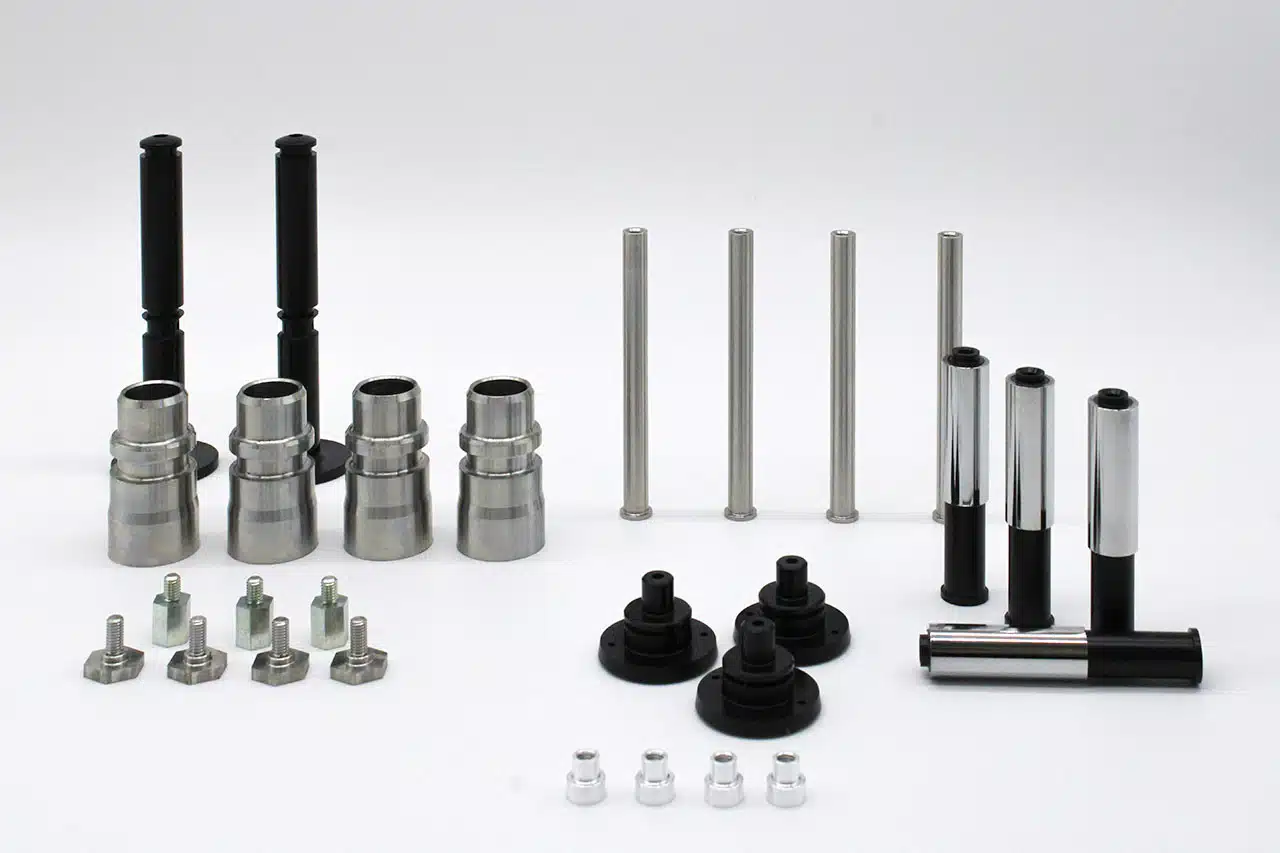
In the food industry, a metal component must not only function: it must be food safe, resist aggressive washing and comply with stringent regulations. For those designing and manufacturing machinery and systems in this sector, the choice of a precision small parts supplier is a decision that concerns both quality and Regulatory compliance.
The food industry is one of the most demanding sectors because.
The metallic components used in food machinery and plants operate under demanding conditions. They are exposed to direct or indirect contact with foodstuffs, constant humidity, natural acids, salts and fats, and cleaning and sanitisation cycles with industrial detergents and high-temperature steam.
Insufficient small parts can corrode, degrade over time or release contaminants, with direct consequences for food safety and the plant's production continuity. For this reason, the sector requires superior-level materials, processing, and controls.
The typical stresses a component is subjected to in the food industry:
- Contact with substances Acidic, saline or fatty
- Frequent washing with aggressive detergents and sanitisers
- Steam and hot water thermal cycles
- Strict requirements for hygiene and absence of contamination
Food contact material regulations
Food contact materials, the so-called MOCA (Materials and Articles Intended to Come into Contact with Food), are regulated at a European level. The framework is the Regulation (EC) 1935/2004, establishing the fundamental principle: materials must not transfer substances to food in quantities that constitute a danger to health, alter its composition or spoil its organoleptic characteristics.
This is also complemented by Regulation (EC) 2023/2006 on Good Manufacturing Practice (GMP), which requires controlled and documented processes.
For the Metals and alloys There is no specific, harmonised measure at a European level at present: the technical reference is the guide from Council of Europe on metals and alloys in contact with food, while in Italy there is also the Ministerial Decree of 21 March 1973 and its updates.
For metal small parts intended for the food industry, all of this translates into two concrete requirements: the choice of a Suitable material food contact and the traceability complete, from start to finish, throughout the entire production cycle.
“In the food sector, compliance is not demonstrated at the end of production; it is built upstream, with the right materials and documented traceability from the very first piece.”
AISI 316 and AISI 304: stainless steels for the food industry
L'Austenitic stainless steel It is the material of reference for the food industry, thanks to its corrosion resistance, ease of cleaning, and stability under correct operating conditions. At MI.SO. we process the two most requested variants by the sector.
AISI 304
L'AISI 304 It is one of the most versatile and widespread stainless steels, with excellent corrosion resistance and good workability. It is the suitable choice for most food applications in non-particularly aggressive environments.
AISI 316
L'AISI 316 offers superior corrosion resistance to AISI 304 thanks to the presence of molybdenum (Mo), making it more effective against chlorides, salts, and acids. It is the correct choice for the most demanding applications: brines, high salt environments, aggressive detergents, and intensive sanitisation processes.
How to choose between the two variants:
- AISI 304 for general food applications in non-aggressive environments
- AISI 316 when present Salt, chlorides or aggressive detergents
- AISI 316 for processes with intensive sanitation or brines
- In both cases, the geometry and tolerances of the component must be evaluated along with the material.
Turning plastics for food contact: PEEK and POM-C
Metal isn't always the best solution. In some food industry applications – where lightness, insulation, low friction, or specific chemical resistance are needed – Engineering plastics turning are the most suitable alternative. At MI.SO. we process two technopolymers that are particularly suitable for contact with food: PEEK e POM-C.
PEEK
The PEEK Polyetheretherketone (PEEK) is a high-performance technopolymer: it resists elevated temperatures, aggressive chemicals, and sanitisation cycles, while maintaining excellent dimensional stability. It is suitable for components operating in harsh conditions, even in contact with steam and hot water.
POM-C
The POM-C (polyoxymethylene copolymer) combines excellent workability, good wear resistance and a low coefficient of friction, with high dimensional stability. It is a popular choice for precision mechanical components such as gears, bushes, and guides.
When a technical plastic is preferable to metal
- Reduction of Weight of the component
- Isolation Electric or thermal
- Low friction without the need for lubrication
- Chemical resistance to detergents and specific agents
Contact us for a material consultation
Precision and traceability: the value of certified small parts
Choosing the right material is the first step. The second is to produce the component with the precision and documentation the sector requires.
In MI.SO. we produce precision small parts with 23 used CNC lathes with travelling steady, its diameters of 3 a 32 mm. Each order is followed by a system of structured quality control, With 130 daily checks performed with high-precision instrumentation such as Keyence IM-8020 e Zeiss O-Inspect 322.
Certification ISO 9001:2015 formalises processes, responsibilities and traceability requirements. At the end of each project, the client receives a certificate of conformity which documents the measurements taken and confirms compliance with the technical drawing specifications.
What does it mean, in concrete terms, for food producers:
- Suitable material food contact, selected together with the client
- Full traceability of the manufacturing cycle, to support supplier qualification processes
- Dimensional coherence on lots of any size, from the first piece to the last
- ISO 9001:2015 documentation that Simplify compliance management downstream
Rely on a partner that knows industry requirements
In the food sector, the difference between a compliant and a problematic component hinges on details that must be defined before production: material, tolerances, finishes, and traceability.
At MI.SO. we support customers right from the design phase: our technical department analyses your drawing and provides you with concrete feedback on materials, workability and documentary requirements, guiding you from prototyping right through to mass production.