
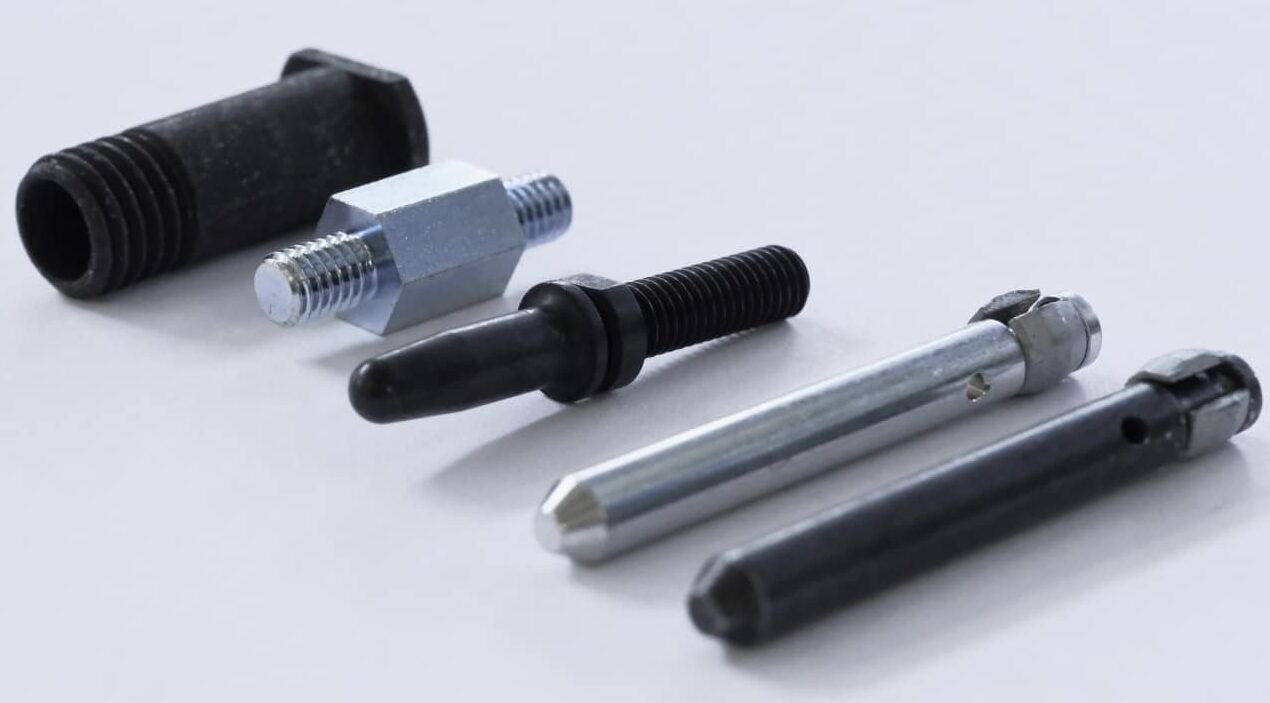
Producing turned components with the correct dimensions is the starting point. But the final performance of a component often depends on what happens after machining: surface and heat treatments that modify its chemical, mechanical, and visual properties.
What are treatments and why are they necessary?
A turned component may have the correct dimensions but not always the surface properties required by the application. The surface may be too vulnerable to corrosion, too soft to withstand wear, or unsuitable for contact with certain fluids or materials.
The treatments address this very issue: they modify the surface or the internal structure from the component to make it suitable for its intended use. Without proper treatment, even a dimensionally perfect component can fail in service.
Electroplating treatments: surface protection and functionality
Electroplating treatments they deposit a layer of material on the surface of the component through electrochemical processes. The layer can have protective function, Functional o Aesthetics, depending on the material deposited and the thickness applied.
Nickel plating
Nickel plating deposits a layer of nickel onto the component's surface. It is one of the most versatile treatments: it offers good corrosion resistance, increases surface hardness, and enhances the aesthetic appearance with a bright or satin finish.
When to useComponents for automotive and precision mechanics that require resistance to wear and corrosion in moderately aggressive environments. Also suitable for components with an aesthetic function.
Compatible materialsSteel, brass, aluminium.
Galvanising
Galvanising deposits a layer of zinc that protects the underlying metal through cathodic protection: the zinc corrodes instead of the component, preserving its structural integrity. It is the most widespread anti-corrosion treatment for steel components.
When to useComponents made of steel exposed to humidity or weathering, screws and fittings for industrial applications, automotive components in non-extreme environments.
Warninggalvanising is not suitable for components intended for environments with intense acids or chlorides, where stainless steel or more high-performance treatments are preferable.
Chrome plating
Chrome plating deposits a layer of chromium that provides high surface hardness, resistance to wear, and a distinctive aesthetic appearance. There are two main types: hard chrome plating, geared towards mechanical performance, and decorative chrome plating, geared towards aesthetics.
When to useComponents subject to heavy wear and friction, shafts and pins sliding in guides or bearings, aesthetic components for design and furnishings.
Tempering and bluing
Copper plating deposits a layer of copper, often used as an intermediate layer before other treatments to improve adhesion. Brass plating deposits an alloy of copper and zinc, used primarily for aesthetic purposes or as a preparation layer.
When to useas a base layer for subsequent treatments, components for electronics and electrical engineering where high conductivity is required, decorative applications.
Anodic oxidation (anodising)
Anodising is a specific treatment for aluminium that creates a layer of oxide on the surface, increasing its hardness and resistance to corrosion. Unlike classic electroplating treatments, it does not deposit external material but transforms the superficial layer of the component itself.
When to useAluminium components for automotive, aerospace, medical and design that require corrosion protection and the possibility of surface colouring.
Heat Treatments: Altering Mechanical Properties in Depth
Heat treatments they act on the crystalline structure of the metal through controlled cycles of heating and cooling. Unlike electroplating treatments, they do not alter the surface but the mechanical properties of the entire component or deeper layers.
Tempra
Tempering is the most common heat treatment for increasing the hardness of steel. The component is heated to high temperatures and then rapidly cooled in water, oil, or air, depending on the steel and the required properties. Rapid cooling “locks in” a harder crystalline structure.
When to use: components subject to high mechanical stress, intense wear or shock loads. Pins, shafts, gears and tools are the most typical examples.
WarningHardening increases hardness but can reduce ductility. This is why it is often followed by tempering.
Discovery
The tempering process almost always follows hardening. It consists of heating at a lower temperature than hardening, which reduces internal stresses and increases the component's toughness, balancing hardness and impact resistance.
When to use: always in combination with hardening, for components that need to be both hard and tough, such as drive shafts, pins, and automotive components.
Remediation
Hardening and tempering is the combination of hardening and tempering carried out in an optimised sequence. It is the benchmark treatment for achieving the best balance between mechanical strength, hardness and toughness in structural steels.
When to useAutomotive and mechanical components requiring high and reliable long-term mechanical performance.
Cementation
Case hardening enriches the surface layer of carbon steel, creating a hard, wear-resistant surface that protects a tougher core. It is the ideal treatment for components that need to be hard on the surface but resistant to impact in depth.
When to useGears, sprockets, shafts and components subject to intense surface wear with dynamic loads. Widely used in automotive and precision mechanics.
Recooking
Annealing is a treatment that softens metal after processes that have increased its internal stresses, such as cold working or welding. It improves workability and restores ductility.
When to usebefore subsequent machining operations on components with residual stresses, or to improve the machinability of materials hardened during the production process.
How to choose the right treatment
The choice of treatment It depends on three main factorsthe component's material, the conditions of use, and the final properties required.
- Corrosion resistance in moderate environmentszinc plating for steel, anodising for aluminium
- Corrosion resistance in aggressive environmentsnickel-plating or stainless steel without treatment
- Surface hardness and wear resistancehard chromium plating or case hardening
- High mechanical performanceTempera + tempering (heat treatment)
- Surface hardness with internal toughnesscementation
- Aestheticsnickel plating, decorative chrome plating, coloured anodising
In many cases, the optimal treatment emerges from the analysis of the technical design and operating conditions. There is no universal answer, but a path that starts from the component's specifications.
The advantage of a single supplier
Managing production and treatments with separate suppliers means difficult-to-coordinate timings, responsibilities, and quality standards. At MI.SO., they are part of the same process: the customer receives the finished component – processed, treated, and inspected – with complete traceability and a single point of responsibility.
“Incorrect treatment of a dimensionally perfect component still produces a non-conforming component. This is why inspection must be continuous, from start to finish.”
Treatments and quality control
Every component processed in MI.SO. is subject to the same work checks: dimensional checks with Keyence IM-8020 and Zeiss O-Inspect 322, finishing with a rugosimeter, and hardness with a durometer where required. The certificate of conformity issued to the customer includes the specifications of the applied treatment, with full traceability. ISO 9001:2015.
If your project requires turned small parts with galvanic or thermal treatments, we can handle the entire process in-house: from processing to treatment, right through to quality control and delivery.